
Searching Conejos County Criminal Dockets
Need an advisement, pretrial conference, plea, trial, or sentencing date? Begin with the free Colorado Judicial Branch Docket Search. Pick Conejos County and a date or range. Then add at least one more filter. A date by itself will not run the search. A party name works when the case number is unknown. A known number is stronger, though, because Colorado splits it into a four-digit year, a case class, and a sequence.
One caution: hearing results are not a full criminal history. The paid CoCourts register-of-actions service supplies a real-time event trail for many state cases. That vendor record is not the official court file. It carries no document images. Follow this order:
- Select Conejos County and a current date range in Docket Search.
- Add the party name or the year, class, and sequence from the case number.
- Check the hearing type, courtroom, appearance type, and location in the result.
- Use an ROA for filings, minute orders, settings, and disposition events.
- Request the complaint, order, or certified record from the Conejos clerk.
Conejos Criminal Classes in Docket Search
Searches often fail because of the class, not the court. Not every Conejos County criminal record wears a CR label. The statewide record form sorts criminal matters into CR, JD, M, T, and R. M points to a misdemeanor file. T covers traffic matters. CR anchors felony work. A felony complaint can open in County Court and later move to District Court. That move may create a different court file or case number for the same matter.
- CR
- A criminal class commonly used for felony proceedings in District Court.
- M
- A misdemeanor class handled through County Court.
- T
- A traffic class that can include a criminal-traffic matter.
- Case sequence
- The numeric part assigned after the filing year and class.
Rely on the court and case class printed on the most recent notice. If the paperwork leaves you unsure, hand the clerk the party name, the rough year, and the type of charge instead of guessing at a class.
Inside a Conejos County Criminal Docket
Rely on the court and case class printed on the newest notice you hold. When those details are unclear, hand the clerk a party name, the approximate year, and the charge type instead of guessing.
| Case number | The filing year, class, and sequence, shown as year + CR + sequence. |
|---|---|
| Caption and parties | The formal case name and the people or entities listed in it. |
| Charges | The complaint or information may state charges; the ROA may summarize them. |
| Settings | Dates for advisement, pretrial work, plea, trial, or sentencing when shown. |
| Minute orders | Brief entries recording action taken by the court. |
| Disposition | The recorded outcome of a case or charge when the event history includes it. |
The full complaint, disposition order, sentence order, or protection order sits behind its index entry. Get those papers from the clerk.
Conejos County Criminal Clerk Channels
One clerk operation serves both County Court and District Court files at Conejos Combined Court. Felix Gallegos is the listed Clerk of Court. Ask that office for help. It can pull a criminal ROA, look over an access request, and hand you a complaint or disposition order where public access allows. The clerk also accepts the official online Record/Document Request Form. Fill in the filing year, the county, and the case type. Add party details and the exact document you want. That precision speeds up the docket search.
Conejos Combined Court
Temporary counter: 603 Main Street, Antonito, CO 81120
Mail: P.O. Box 128, Conejos, CO 81129
719-376-5465
ConejosClerk@judicial.state.co.us
Monday through Friday, 8:00 a.m. to 4:00 p.m., except state holidays
Conejos Combined Court runs one clerk operation for both County Court and District Court files. Felix Gallegos is the listed Clerk of Court. His office can locate a criminal ROA. It can review an access request and hand over a complaint or disposition order when public access permits. The online Record/Document Request Form is one route. It asks for the filing year, county, case type, party details, and the exact product wanted.
How a Criminal Case Moves
Read a criminal docket in time order. The court record opens with a complaint or information. An advisement or arraignment comes next, covering the charge and what follows. Bond and release conditions may show up after that. Pretrial settings and motions often fill the middle stretch, and then the docket may record a plea or trial, a disposition, a sentence, and any appeal activity. Plenty of cases skip stages entirely. And remember, a label on the calendar proves nothing about what actually happened in the courtroom that day.
Conejos criminal docket flow: Complaint or Information › Advisement or Arraignment › Bond and Pretrial Settings › Plea or Trial › Disposition › Sentencing › Appeal, if filed
Bond data lives in its own corner of the record system. The Judicial Branch bond-status report explains that split, which is why it stands apart from the Conejos County criminal docket itself.
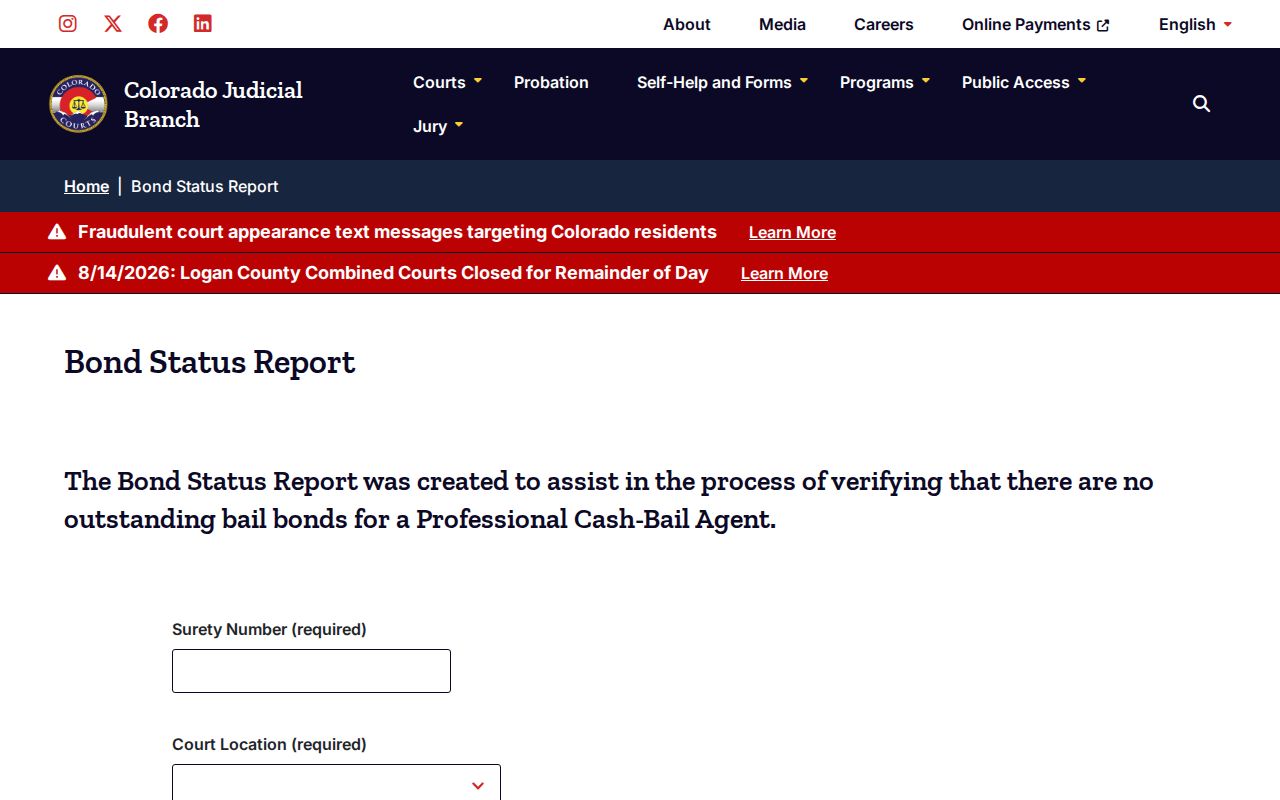
The Judicial Branch bond-status report answers a narrower question than the Conejos County criminal docket. It reports bond status, not case events.
Conejos County Criminal Hearing Locations
Fire damage has closed the permanent Conejos County courthouse until further notice. Criminal proceedings and clerk service have moved. Most of them now take place at the S.P.M.D.T.U. Concilio Superior, 603 Main Street in Antonito. Trials can land somewhere else, though. The address on your summons or most recent hearing notice always controls, so read it before you travel. Docket Search will show the location, courtroom, and appearance type; if that does not match your paperwork, call or email the clerk to sort it out.
Do not confuse appearance type with hearing type. The docket entry tells you whether an appearance is in person or remote, while the hearing type names the court event itself. A WebEx room listed on the docket is not permission to show up online. Remote appearance still requires the hearing notice or a motion the court has approved. One more wrinkle: an older setting can linger in the case history after a reset, so rely on the newest entry for how and where to appear.
Courts That Hold Criminal Dockets
Two state courts split the Conejos County criminal docket. County Court takes misdemeanors, criminal traffic, minor infractions, and the first felony complaint. District Court then handles the felony prosecution itself. So a felony that started in County Court may later show up only in the District Court docket. The Combined Court clerk serves both levels. Yet the filing court and the charge class still drive any Conejos County docket search.
Other courts sit outside this system entirely. A municipal-ordinance case stays with the municipal court that issued the summons. A federal charge belongs to the U.S. District Court for the District of Colorado. Appeals run separate routes as well. County criminal judgments go up to District Court. District Court felony appeals usually land in the Colorado Court of Appeals.
Conejos Criminal Docket Documents and ROAs
The clerk's request form draws a line between a Register of Action and something else. That something is the actual papers the ROA indexes. Criminal options include several items. These are Complaint/Information, Disposition/Sentence Order, Protection Order, Ticket, and Register of Action/ROA. Request the one narrow item you need. A vendor's ROA will not yield a certified order. And the free hearing search cannot display the authoritative filed complaint.
Access itself can change through a court process. The Judicial Branch conviction-sealing guide lays out that procedure with its forms.
That guide is a forms resource and nothing more. The clerk remains the true source for the status and contents of a specific Conejos record. The Seal My Case forms hub sorts the routes for arrests, non-convictions, convictions, municipal matters, and juvenile records.
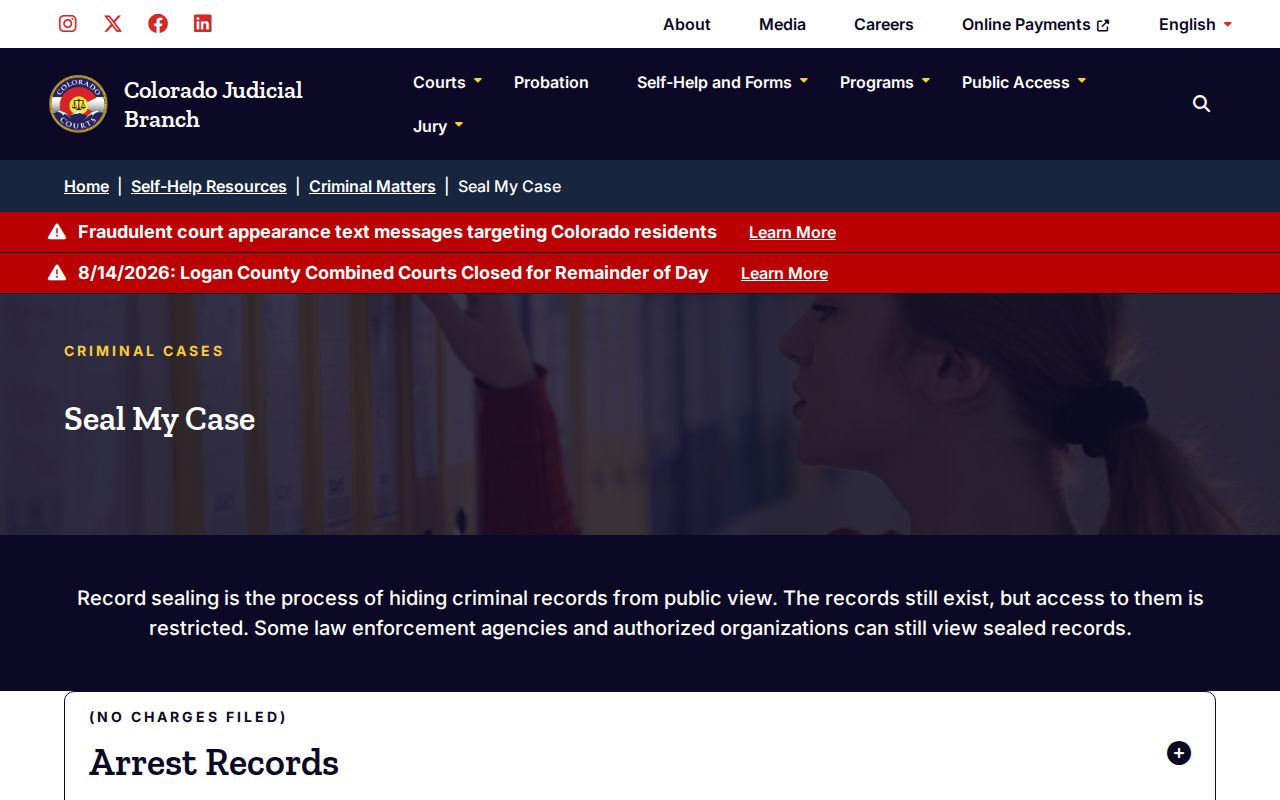
Those separate routes also show why a blank public result proves nothing about how a case ended.
Conejos County Criminal Docket Codes
A few plain terms prevent big mistakes. A setting is a scheduled appearance, hearing, or trial. A continuance or reset moves it to a new date. A minute order is a brief court record of action taken. Disposition means the recorded procedural end of a case or charge. A sentence order is the written result of criminal sentencing. Active or pending tells you the trial-level case has not fully closed; disposed or closed still leaves room for later filings or an appeal.
Treat names as leads only. Before trusting a docket entry, match the name against the case year, class, sequence, court, and charge details. Spelling differences can split one trail in two. A felony transferred between courts can do the same. For a wider search, try the Conejos County case lookup by name or number, then confirm what you find against the actual court record.
Sealed Dockets and Public Access
Colorado sorts court records into Public, Protected, Restricted, Suppressed, and Sealed material. Protected material may go public once required redactions are made. Restricted and suppressed records stay with authorized groups only. Sealed material is generally limited to judges and Judicial Department staff. Legal authority can open the door. Juvenile records and victim-identifying information carry added limits. Bring government photo identification, and be ready to show entitlement, for anything nonpublic.
The official sealed-case access page walks through a separate path. That path is for a record that ordinary search will not expose.
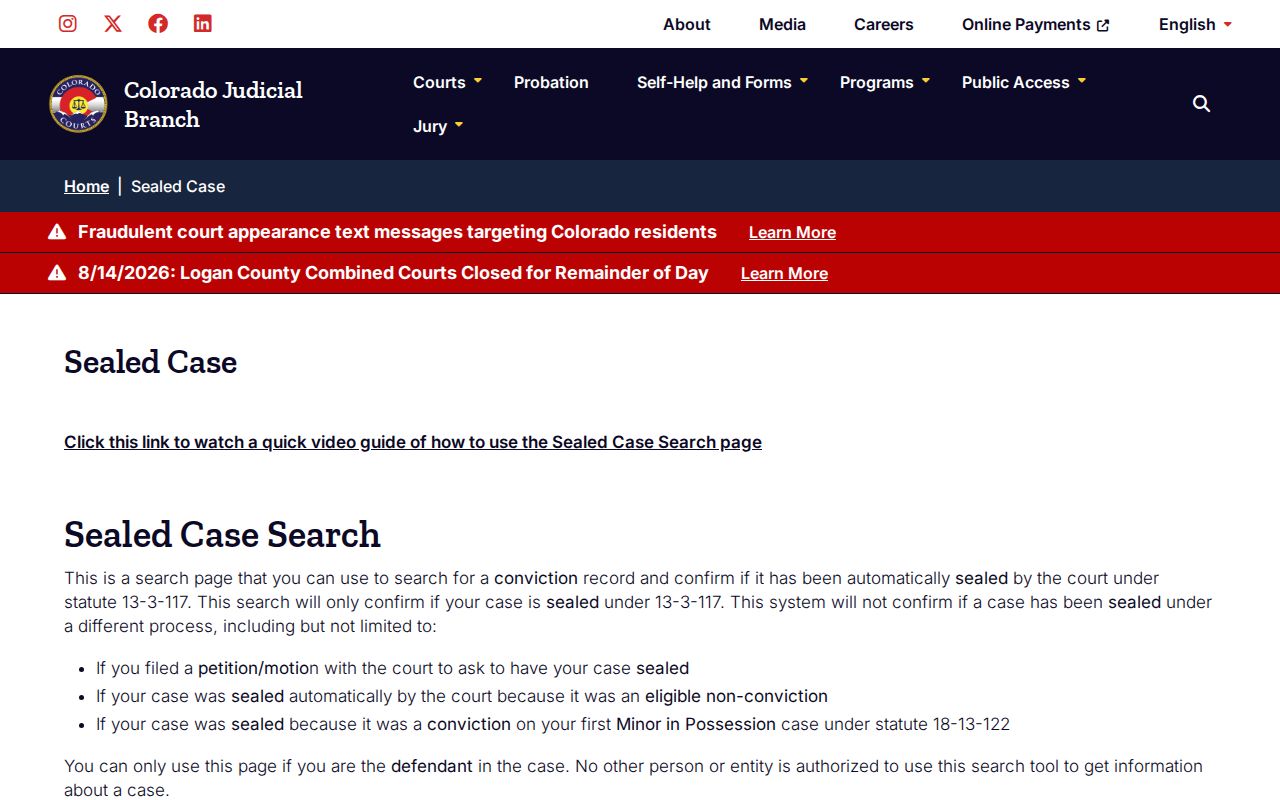
A name that returns nothing in public search is not a mystery with one answer. Sealing, another access class, archive status, a wrong class, or a municipal file could each explain it. The Colorado Legislative Council sealing overview gives a statewide explanation of the sealing and expungement routes.
That overview is broad by design. It cannot replace the court order or the Conejos clerk's access decision in a specific file.
Access rules: Chief Justice Directive 05-01 governs access to Colorado court case records. The Colorado Criminal Justice Records Act permits custodian rules and allows denial when law, court rule, court order, or the public interest requires it.