
Getting Conejos County Court Records
Figure out first what you actually need. It might be a hearing date, a register of actions, or a filed paper. The free Colorado Judicial Branch Docket Search covers scheduled events. A Judicial Branch-listed commercial vendor can show a real-time ROA for many state cases for a charge. It cannot deliver document images. It also cannot produce a certified official file. For District Court and County Court documents, the Conejos Combined Court clerk is the source. Town-ordinance files live with each municipal clerk. The official Record/Document Request Form is the main online channel. One form handles an ROA request, a named paper, or certification. There are other channels too. Conejos County court records can also be requested at the temporary counter, by mail, phone, or email. Go direct in some cases. Use that route when the case is old, the case number is incomplete, or online results miss the item.
- Identify the filing court, case class, party name, and approximate year. Add the full case number when known.
- Name the exact item, such as an ROA, complaint, decree, order, judgment, ticket, or sentence order.
- Submit the statewide web form, visit the clerk, email or call, or mail a written request. Municipal records go to that town clerk.
- Wait for the access review and fee notice. Do not place credit-card details in the printable request form.
- Pay by an accepted method, then receive ordinary results by email or certified results by U.S. mail as directed.
Conejos County Court Record Form
The online form gathers contact information plus a mailing address with state, city, and ZIP. Case fields cover plenty. They include case number, type, filing year, county or location, party name, birth date if known, and other details. You then pick a document category. Family, criminal, civil, probate, ROA, and certification choices are built in. Precise entries matter. They help the clerk separate a Conejos County court record from a similar name or a file in another court. The Judicial Branch sets a response target of three business days. That holds unless extenuating circumstances apply. But that target is not a promise. A large or archived file can take longer. Research, redaction, off-site retrieval, certification, and mailing can stretch well past three days. The Judicial Branch request page shows the filing screen used statewide.
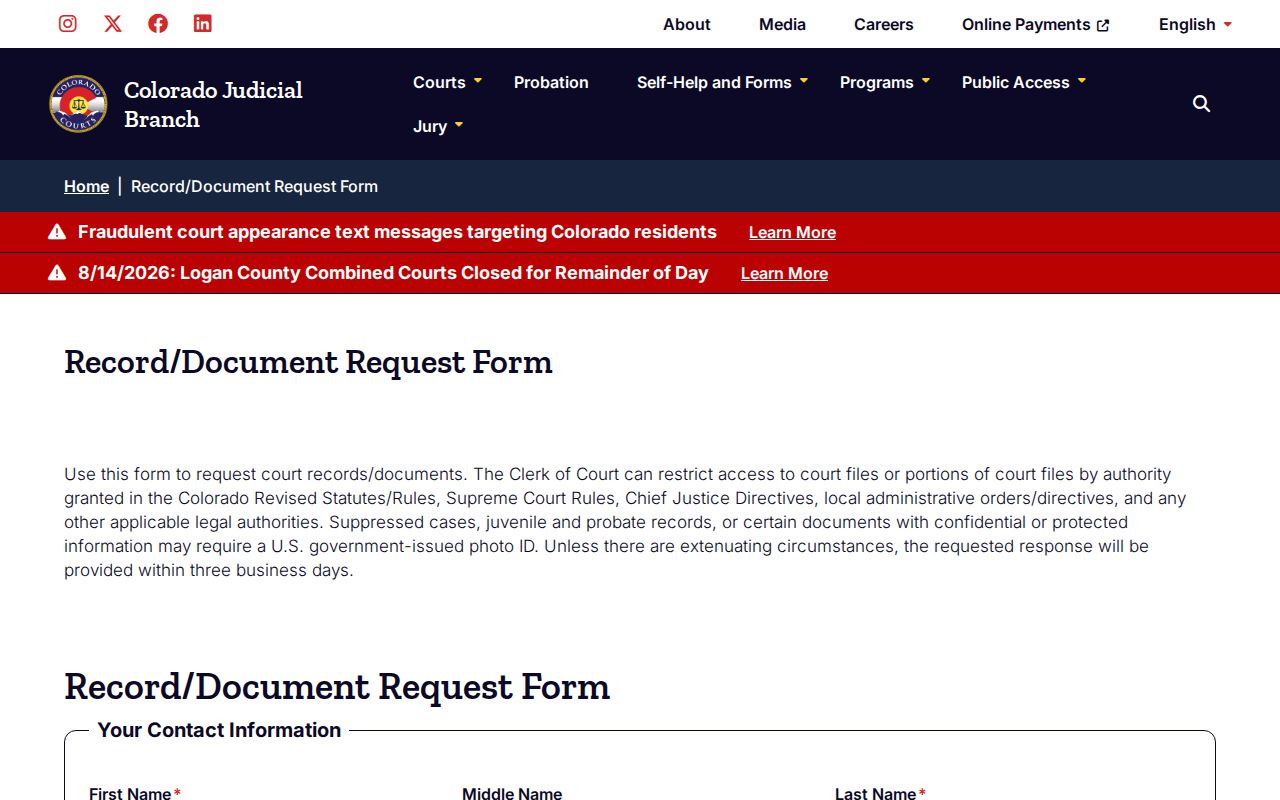
The form's own fields make the point plainly. A specific document title with filing details beats a broad request for everything filed under a name.
Court Record Types
A Conejos court file holds several distinct products. A docket is the schedule of hearings. The ROA is a short chronological history noting filings, settings, minute orders, charges, and sentences. Filed papers are the actual pleadings and court orders behind those entries. A certified or exemplified copy is a clerk-authenticated version of a chosen paper. It is not a richer search result.
- Criminal records, including a complaint or information, ticket, protection order, and disposition or sentence order
- Civil records, including an order for judgment, transcript of judgment, satisfaction, and protection order
- Family records, including petitions, decrees, parenting plans, separation agreements, and support orders
- Probate records, including wills, trusts, letters, applications, petitions, claims, and closing papers
- Registers of actions, plain copies, certified copies, and exemplified copies
Ask for the narrowest useful item. An ROA may show that an order was entered, but only the order itself carries the full ruling. Note too that a transcript of judgment differs from a hearing transcript.
Conejos County Court Record Custodians
Conejos Combined Court runs on a unified state clerk. Felix Gallegos is listed as Clerk of Court. The office holds Conejos District Court records. Felonies, any-dollar civil disputes, domestic relations, juvenile, probate, and mental-health cases all sit there. Conejos County Court records sit there too. Those cover misdemeanors, traffic, felony complaints, protection orders, small claims, and civil cases within County Court jurisdiction. Municipal-ordinance records stay with Manassa, Sanford, La Jara, or Antonito. Those town files may not appear in state Judicial Branch data. An appeal can create a separate record in District Court or an appellate court. So search the court of filing. Do not rely on the town where the event happened.
| Record | Primary Custodian | Best First Step |
|---|---|---|
| District or County Court case file | Conejos Combined Court clerk | Use the official request form or clerk contact |
| Municipal-code case | Issuing town court or clerk | Read the citation, then contact that town |
| Appeal file | District or appellate clerk | Use the appellate case number and court |
Inside a Conejos County Court Record
Read a returned Conejos County court record in layers. The identifying fields fix the court and case. The chronological register points to events. Pleadings show what parties asked the court to do. Orders and judgments show what the court decided. Keep in mind that redacted or withheld fields mean a copy is not necessarily every paper inside the internal file.
| Case number | A four-digit year, case class, and numeric sequence, such as 2019T999999. |
|---|---|
| Case identity | Court, division, caption, parties, counsel, and assigned judicial officer where shown. |
| Register of actions | A dated trail of accepted filings, settings, minute orders, rulings, and disposition activity. |
| Filed papers | Complaints, petitions, motions, responses, orders, judgments, decrees, tickets, or related attachments. |
| Access treatment | Public release, redacted copy, restricted access, suppression, or sealing under the governing rules. |
A fuller case history can come through a Conejos County case lookup. Still, the clerk-held paper remains the official record.
Conejos County Court Record Counter
The permanent county courthouse stays closed after a fire. Clerk service now runs from the S.P.M.D.T.U. Concilio Superior in Antonito, while the mailing address remains in Conejos. Call or email first. Do that for an old file, a large request, or a late-day trip. The Judicial Branch does not promise a public computer terminal at the temporary site.
Conejos Combined Court Clerk
603 Main Street
Antonito, CO 81120
Mail: P.O. Box 128, Conejos, CO 81129
Monday-Friday, 8:00 a.m.-4:00 p.m.
719-376-5465
ConejosClerk@judicial.state.co.us
Counter staff can confirm the file, its access level, the likely fee, and the delivery route. That beats mailing a request blind.
Fees and Certified Copies
A plain copy just reproduces a court paper. Certification adds the clerk's authentication, and exemplification provides enhanced formal authentication. Ask the recipient which form is required before paying. The online-request estimates and the JDF 1 schedule use different copy categories. Do not blend the rates. Clerk-produced filed-document copies on JDF 1 carry a higher per-page rate. The web request estimate is lower.
| Item | Published Amount | Scope |
|---|---|---|
| Online-request copy estimate | $0.25 per page | Party or party-attorney maximum is $15; no nonparty maximum |
| JDF 1 clerk-produced filed copy | $0.75 per page or $1.50 double-sided | Ask which schedule applies to the delivery method |
| Certified or exemplified copy | $20 per document | Added to applicable copy cost |
| Transcript of judgment | $25 | A judgment record, not a hearing transcript |
| Certificate of satisfaction | $20 | Shows satisfaction of a judgment obligation |
| Name search | $5 | Use full name and other known identifiers |
| Research and redaction | $30 per hour | In 15-minute increments after the first hour |
Off-site retrieval is billed at actual cost. Under the April 2025 printable process, a fee notice arrives by email. You then pay by check, certified funds, or credit card by phone with the assigned researcher.
Conejos County Court Record Transcripts
A hearing transcript is its own product, ordered on JDF 4. That form wants the case number, the county, the caption, and the division or courtroom, plus the judicial officer and the date, time, and type of each event. Contact details and accessibility needs go on it too. Do not confuse this with asking for an ROA or a transcript of judgment.
The rates depend on speed. Ordinary delivery within 30 days runs $3.60 per page. Expedited work within 10 days costs $4.35 per page. Overnight or daily work is $5.85 per page, and two-hour work is $6.85 per page; a court order is required for both. Extra copies run from $1.35 to $1.85 per page. In the specified small-claims appeal setting, a $35 audio recording can fill the need. Order any of these record products only after you have pinned down the hearing in enough detail.
Conejos County Court Record Rules
Colorado splits its record rules by record type. Chief Justice Directive 05-01 covers case files held in Judicial Branch custody, from inspection and copies to electronic requests, exclusions, and redaction. P.A.I.R.R. 2 is different. It governs Judicial administrative and operational records, not the pleadings and orders in a court case. The Colorado Criminal Justice Records Act, including C.R.S. sections 24-72-304 and 305, handles criminal justice records and permits custodial rules or denial when law, court rule, court order, or the public interest calls for it. The Judicial Branch CJD 05-01 page identifies the current case-record directive.
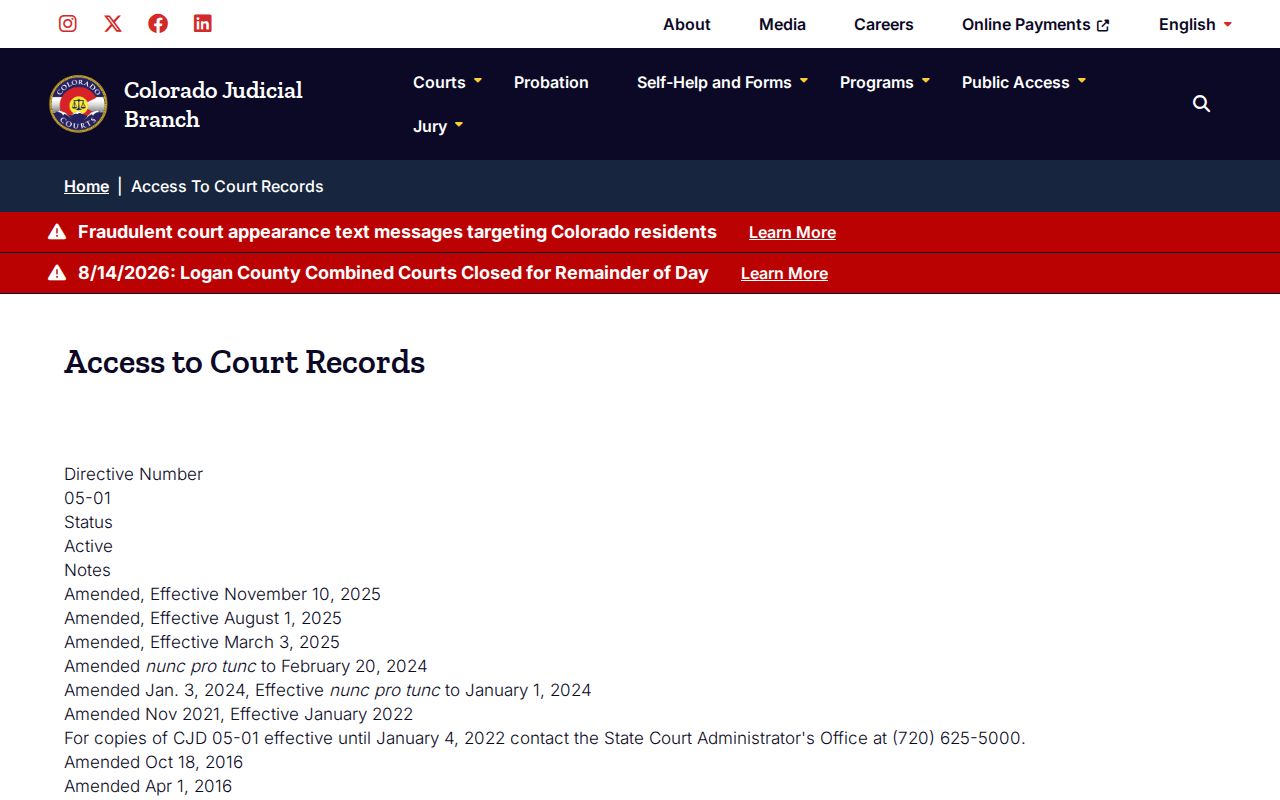
That directive, not an administrative-record rule, is what governs ordinary Conejos case-file inspection and copy requests. The Colorado Supreme Court rule-change page documents the P.A.I.R.R. 2 update.
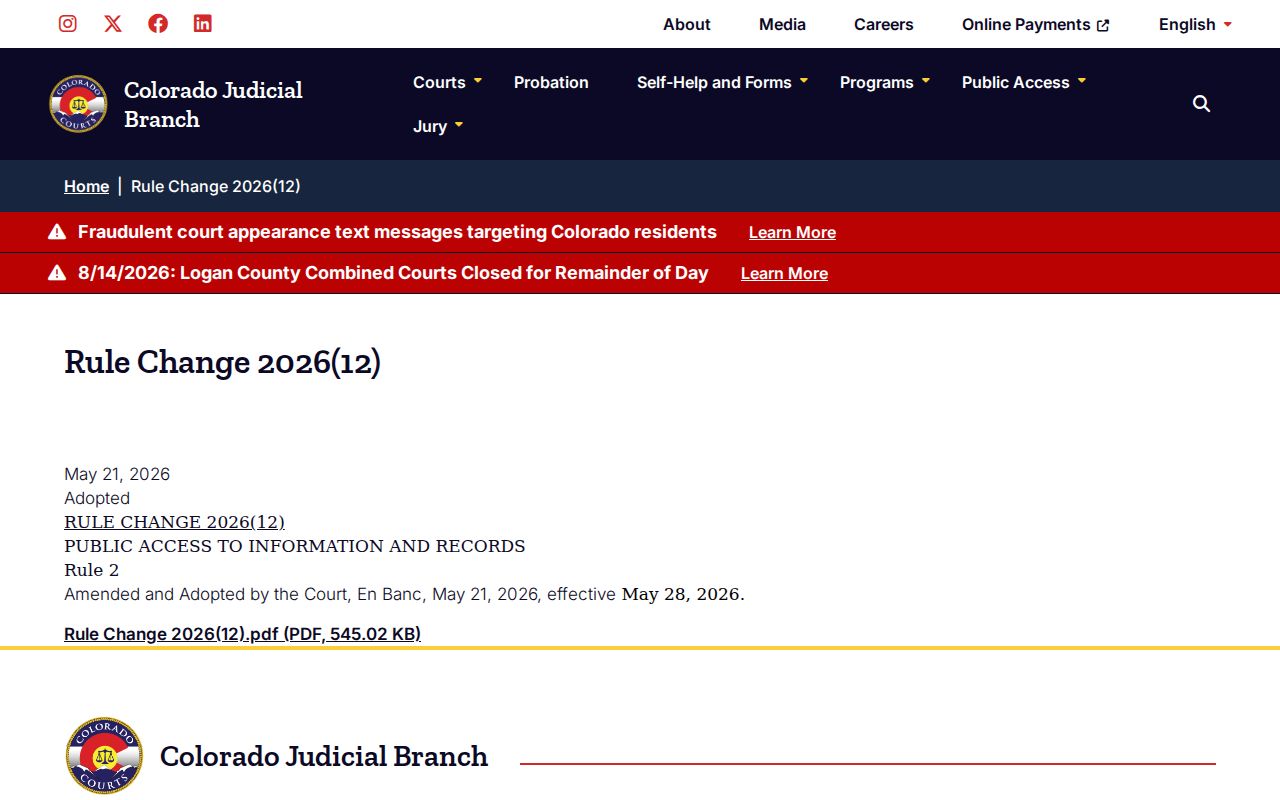
Keeping the two apart matters: administrative Judicial records are one thing, Conejos County court case documents another.
Sealed Records and Public Access
Public access does not mean everything opens without review. Colorado tags electronic material as Public, Protected, Restricted, Suppressed, or Sealed. Protected material goes public only after redaction. Restricted and suppressed material goes to defined authorized users. Judges and Judicial staff alone see sealed material, unless authority allows wider access. Juvenile files, victim-identifying details, personal identifiers, and some probate material carry extra limits.
Access rules: CJD 05-01 governs Judicial case records and section 4.60 addresses exclusions and redaction. P.A.I.R.R. 2 covers administrative Judicial records. C.R.S. sections 24-72-304 and 305 address criminal justice record inspection and withholding. C.R.S. section 24-72-705 provides a route for qualifying non-conviction sealing, while the Children's Code controls juvenile availability.
The Colorado Judicial Public Access Committee describes its court-record access work.
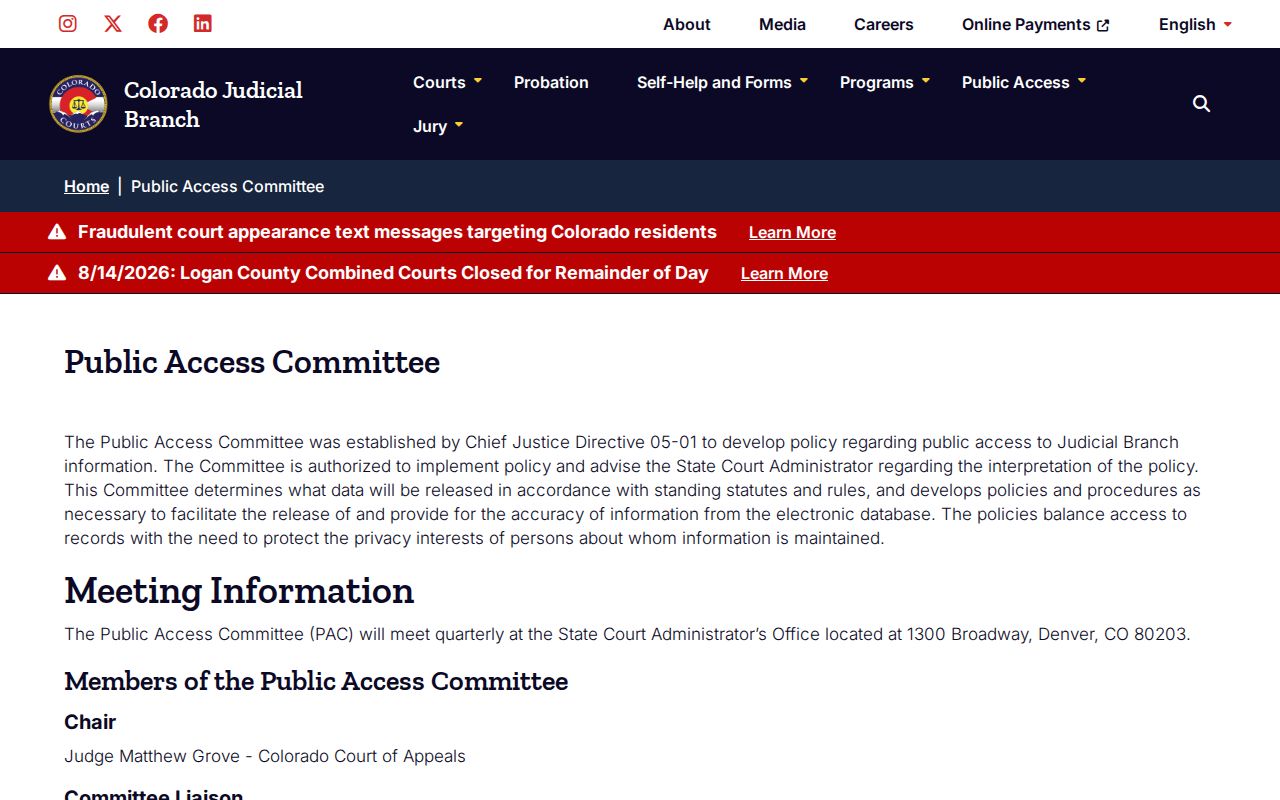
Committee material offers statewide context on balancing access against privacy and safe court operations. The Court Data-Sharing Task Force records the gap between state and municipal systems.
That gap is why a town-code file may need a direct municipal request even when a state search turns up nothing. A blank online result proves very little. It cannot show that a case never existed, was dismissed, or was sealed. Confirm the court and case class first, then ask the proper custodian.